
News

DOWNLOAD TRACE 2.0
DISCLAIMER: This tool is no longer supported by ESMAP and it's being made available to all at the user's own risk.
The Tool for Rapid Assessment of City Energy (TRACE) was first developed in 2008 by ESMAP’s Energy Efficient Cities Program to help cities expand their municipal services through energy efficiency. It was designed to give city authorities a quick and easy way to assess their energy use and to identify cost-effective and feasible measures they can take to improve energy efficiency in a variety of public sectors including lighting, water and wastewater, buildings, transportation, solid waste, and power and heating.
It guides users through the process of data collection and sector prioritization —considering key constraints such as technical capacity and finance— to generate specific and integrated recommendations cities can use to improve and expand their energy efficiency efforts. TRACE's benchmarking function allows a city to compare its energy use against a range of peer cities and show the potential energy efficiency improvement the city may realize if it were to match the average of better-performing cities.
WHERE IS TRACE BEING USED?
TRACE has supported the efforts of more than 80 cities to develop long-term energy efficiency strategies and investment pipelines by increasing their understanding of the cross-sectoral energy challenges, helping direct funds for dedicated energy efficiency investments, and pointing to necessary legislative adjustments. It has also improved local administrators’ ability to identify, plan, and implement energy efficiency solutions across sectors.
After almost a decade of successful implementation in more than 80 cities across the globe, TRACE has now undergone a major upgrade. TRACE 2.0 now incorporates almost 100 built-in recommendations for energy efficiency measures as well as simple intervention models for each measure selected. Following requests from municipal officials for more detailed technical and financial analysis, TRACE 2.0 now provides customizable models for each selected intervention. With the help of the intervention “calculators,” users can now quickly calculate the costs and benefits related to each recommendation.
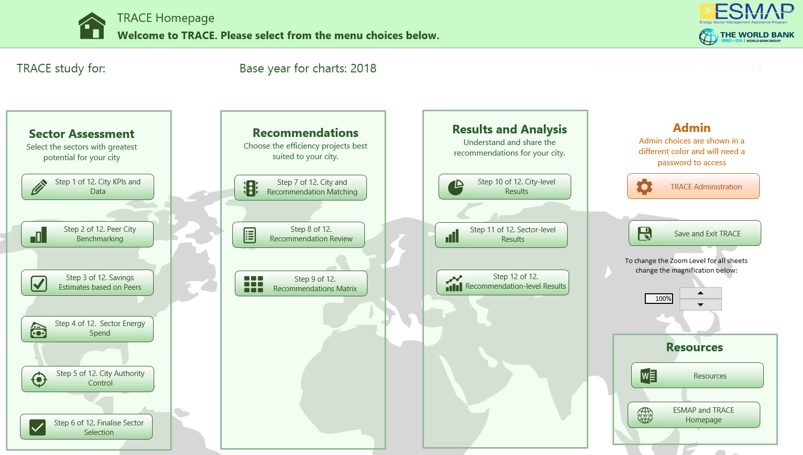
TRACE 2.0 asks users to carry out 12 steps that are divided into three stages:
LIMITATIONS
Although the tool has been upgraded, the user should be aware that TRACE has three main limitations:
-
Its calculations cannot replace thorough technical assessments and cost-benefit analyses for each intervention. Therefore, any investment will require further assessments, including a prefeasibility or feasibility study.
-
The tool does not directly consider institutional and legislative requirements needed to implement the selected energy efficiency measures. Individual assessments are recommended.
-
The tool’s snapshot analysis does not take into consideration future changes to urbanization, such as deurbanization or rapid urbanization. For cities facing those developments, additional analyses are advisable.
WHERE HAS TRACE BEEN DEPLOYED?
List of cities where TRACE has been deployed.
SUPPORT
TRACE 2.0 comes with a practical manual for local city officials and energy experts to provide the training and experience necessary to use the tool to its fullest capacity.
For questions and feedback please contact us at esmap@worldbank.org.
ESMAP | Energy Efficiency | TRACE